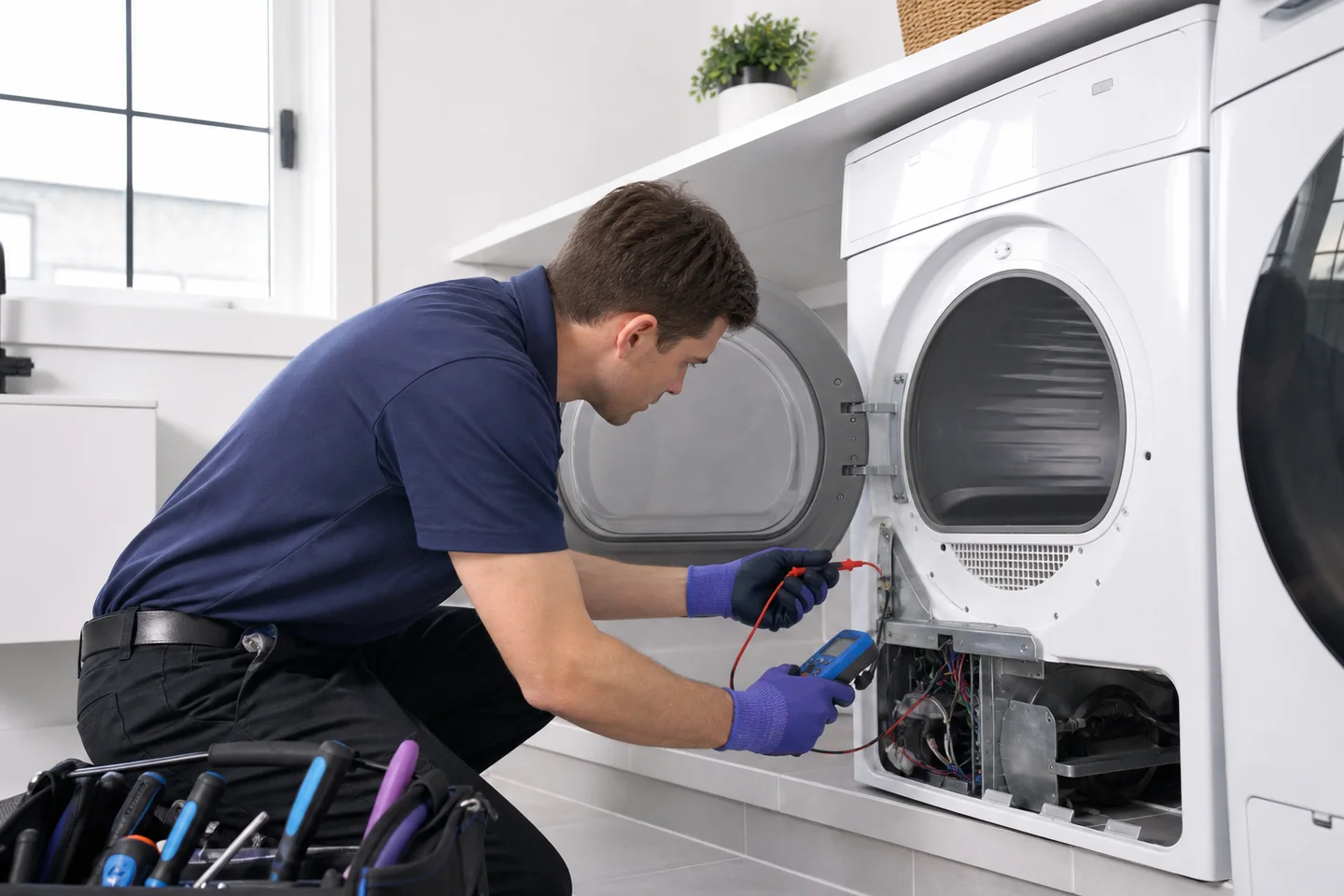
Record whether the drum turns, whether heat is absent or weak, the energy source and visible vent context without live testing or gas work. The objective is a record a qualified service desk can review, not a remote component diagnosis.
Separate no heat from long drying time
Separate no heat from long drying time is a decision point in Dryer not heating: electric, gas and venting service boundaries. Start with evidence that can be recorded without unsafe disassembly: appliance type, complete model information when accessible, exact symptom or error display, cycle or temperature context, energy source, first-observed date and property configuration. State what was observed rather than naming a failed component. A code, sound, leak, frost pattern or stopped cycle can organize inspection questions, but it cannot confirm repairability, parts stock, price, credential requirements or the correct repair method on its own.
At step 1, separate diagnostic evidence from commercial authorization. Ask who can approve attendance, fees, estimate, additional work, parts ordering and follow-up; then keep the answer in the service record. Only a verified technician should open service panels, test live circuits, handle gas or refrigerant, bypass safety controls or select a repair procedure. Record the date, decision-maker, evidence considered and condition that triggers reassessment. If model, access, energy source or diagnosis changes, pause and obtain a revised scope rather than stretching the original request.
Confirm electric, gas or unknown energy source
Confirm electric, gas or unknown energy source is a decision point in Dryer not heating: electric, gas and venting service boundaries. Start with evidence that can be recorded without unsafe disassembly: appliance type, complete model information when accessible, exact symptom or error display, cycle or temperature context, energy source, first-observed date and property configuration. State what was observed rather than naming a failed component. A code, sound, leak, frost pattern or stopped cycle can organize inspection questions, but it cannot confirm repairability, parts stock, price, credential requirements or the correct repair method on its own.
At step 2, separate diagnostic evidence from commercial authorization. Ask who can approve attendance, fees, estimate, additional work, parts ordering and follow-up; then keep the answer in the service record. Only a verified technician should open service panels, test live circuits, handle gas or refrigerant, bypass safety controls or select a repair procedure. Record the date, decision-maker, evidence considered and condition that triggers reassessment. If model, access, energy source or diagnosis changes, pause and obtain a revised scope rather than stretching the original request.
Record drum movement and cycle response
Record drum movement and cycle response is a decision point in Dryer not heating: electric, gas and venting service boundaries. Start with evidence that can be recorded without unsafe disassembly: appliance type, complete model information when accessible, exact symptom or error display, cycle or temperature context, energy source, first-observed date and property configuration. State what was observed rather than naming a failed component. A code, sound, leak, frost pattern or stopped cycle can organize inspection questions, but it cannot confirm repairability, parts stock, price, credential requirements or the correct repair method on its own.
At step 3, separate diagnostic evidence from commercial authorization. Ask who can approve attendance, fees, estimate, additional work, parts ordering and follow-up; then keep the answer in the service record. Only a verified technician should open service panels, test live circuits, handle gas or refrigerant, bypass safety controls or select a repair procedure. Record the date, decision-maker, evidence considered and condition that triggers reassessment. If model, access, energy source or diagnosis changes, pause and obtain a revised scope rather than stretching the original request.
Note displayed codes and control behaviour
Note displayed codes and control behaviour is a decision point in Dryer not heating: electric, gas and venting service boundaries. Start with evidence that can be recorded without unsafe disassembly: appliance type, complete model information when accessible, exact symptom or error display, cycle or temperature context, energy source, first-observed date and property configuration. State what was observed rather than naming a failed component. A code, sound, leak, frost pattern or stopped cycle can organize inspection questions, but it cannot confirm repairability, parts stock, price, credential requirements or the correct repair method on its own.
At step 4, separate diagnostic evidence from commercial authorization. Ask who can approve attendance, fees, estimate, additional work, parts ordering and follow-up; then keep the answer in the service record. Only a verified technician should open service panels, test live circuits, handle gas or refrigerant, bypass safety controls or select a repair procedure. Record the date, decision-maker, evidence considered and condition that triggers reassessment. If model, access, energy source or diagnosis changes, pause and obtain a revised scope rather than stretching the original request.
Describe airflow without disconnecting concealed ducts
Describe airflow without disconnecting concealed ducts is a decision point in Dryer not heating: electric, gas and venting service boundaries. Start with evidence that can be recorded without unsafe disassembly: appliance type, complete model information when accessible, exact symptom or error display, cycle or temperature context, energy source, first-observed date and property configuration. State what was observed rather than naming a failed component. A code, sound, leak, frost pattern or stopped cycle can organize inspection questions, but it cannot confirm repairability, parts stock, price, credential requirements or the correct repair method on its own.
At step 5, separate diagnostic evidence from commercial authorization. Ask who can approve attendance, fees, estimate, additional work, parts ordering and follow-up; then keep the answer in the service record. Only a verified technician should open service panels, test live circuits, handle gas or refrigerant, bypass safety controls or select a repair procedure. Record the date, decision-maker, evidence considered and condition that triggers reassessment. If model, access, energy source or diagnosis changes, pause and obtain a revised scope rather than stretching the original request.
Recognize when to stop using the dryer
Recognize when to stop using the dryer is a decision point in Dryer not heating: electric, gas and venting service boundaries. Start with evidence that can be recorded without unsafe disassembly: appliance type, complete model information when accessible, exact symptom or error display, cycle or temperature context, energy source, first-observed date and property configuration. State what was observed rather than naming a failed component. A code, sound, leak, frost pattern or stopped cycle can organize inspection questions, but it cannot confirm repairability, parts stock, price, credential requirements or the correct repair method on its own.
At step 6, separate diagnostic evidence from commercial authorization. Ask who can approve attendance, fees, estimate, additional work, parts ordering and follow-up; then keep the answer in the service record. Only a verified technician should open service panels, test live circuits, handle gas or refrigerant, bypass safety controls or select a repair procedure. Record the date, decision-maker, evidence considered and condition that triggers reassessment. If model, access, energy source or diagnosis changes, pause and obtain a revised scope rather than stretching the original request.
Find the model information safely
Find the model information safely is a decision point in Dryer not heating: electric, gas and venting service boundaries. Start with evidence that can be recorded without unsafe disassembly: appliance type, complete model information when accessible, exact symptom or error display, cycle or temperature context, energy source, first-observed date and property configuration. State what was observed rather than naming a failed component. A code, sound, leak, frost pattern or stopped cycle can organize inspection questions, but it cannot confirm repairability, parts stock, price, credential requirements or the correct repair method on its own.
At step 7, separate diagnostic evidence from commercial authorization. Ask who can approve attendance, fees, estimate, additional work, parts ordering and follow-up; then keep the answer in the service record. Only a verified technician should open service panels, test live circuits, handle gas or refrigerant, bypass safety controls or select a repair procedure. Record the date, decision-maker, evidence considered and condition that triggers reassessment. If model, access, energy source or diagnosis changes, pause and obtain a revised scope rather than stretching the original request.
Record stacked-laundry access
Record stacked-laundry access is a decision point in Dryer not heating: electric, gas and venting service boundaries. Start with evidence that can be recorded without unsafe disassembly: appliance type, complete model information when accessible, exact symptom or error display, cycle or temperature context, energy source, first-observed date and property configuration. State what was observed rather than naming a failed component. A code, sound, leak, frost pattern or stopped cycle can organize inspection questions, but it cannot confirm repairability, parts stock, price, credential requirements or the correct repair method on its own.
At step 8, separate diagnostic evidence from commercial authorization. Ask who can approve attendance, fees, estimate, additional work, parts ordering and follow-up; then keep the answer in the service record. Only a verified technician should open service panels, test live circuits, handle gas or refrigerant, bypass safety controls or select a repair procedure. Record the date, decision-maker, evidence considered and condition that triggers reassessment. If model, access, energy source or diagnosis changes, pause and obtain a revised scope rather than stretching the original request.
Separate appliance repair from vent cleaning scope
Separate appliance repair from vent cleaning scope is a decision point in Dryer not heating: electric, gas and venting service boundaries. Start with evidence that can be recorded without unsafe disassembly: appliance type, complete model information when accessible, exact symptom or error display, cycle or temperature context, energy source, first-observed date and property configuration. State what was observed rather than naming a failed component. A code, sound, leak, frost pattern or stopped cycle can organize inspection questions, but it cannot confirm repairability, parts stock, price, credential requirements or the correct repair method on its own.
At step 9, separate diagnostic evidence from commercial authorization. Ask who can approve attendance, fees, estimate, additional work, parts ordering and follow-up; then keep the answer in the service record. Only a verified technician should open service panels, test live circuits, handle gas or refrigerant, bypass safety controls or select a repair procedure. Record the date, decision-maker, evidence considered and condition that triggers reassessment. If model, access, energy source or diagnosis changes, pause and obtain a revised scope rather than stretching the original request.
Apply the gas-credential gate
Apply the gas-credential gate is a decision point in Dryer not heating: electric, gas and venting service boundaries. Start with evidence that can be recorded without unsafe disassembly: appliance type, complete model information when accessible, exact symptom or error display, cycle or temperature context, energy source, first-observed date and property configuration. State what was observed rather than naming a failed component. A code, sound, leak, frost pattern or stopped cycle can organize inspection questions, but it cannot confirm repairability, parts stock, price, credential requirements or the correct repair method on its own.
At step 10, separate diagnostic evidence from commercial authorization. Ask who can approve attendance, fees, estimate, additional work, parts ordering and follow-up; then keep the answer in the service record. Only a verified technician should open service panels, test live circuits, handle gas or refrigerant, bypass safety controls or select a repair procedure. Record the date, decision-maker, evidence considered and condition that triggers reassessment. If model, access, energy source or diagnosis changes, pause and obtain a revised scope rather than stretching the original request.
Estimate and parts authorization questions
Estimate and parts authorization questions is a decision point in Dryer not heating: electric, gas and venting service boundaries. Start with evidence that can be recorded without unsafe disassembly: appliance type, complete model information when accessible, exact symptom or error display, cycle or temperature context, energy source, first-observed date and property configuration. State what was observed rather than naming a failed component. A code, sound, leak, frost pattern or stopped cycle can organize inspection questions, but it cannot confirm repairability, parts stock, price, credential requirements or the correct repair method on its own.
At step 11, separate diagnostic evidence from commercial authorization. Ask who can approve attendance, fees, estimate, additional work, parts ordering and follow-up; then keep the answer in the service record. Only a verified technician should open service panels, test live circuits, handle gas or refrigerant, bypass safety controls or select a repair procedure. Record the date, decision-maker, evidence considered and condition that triggers reassessment. If model, access, energy source or diagnosis changes, pause and obtain a revised scope rather than stretching the original request.
Verify heat, drum and cycle performance
Verify heat, drum and cycle performance is a decision point in Dryer not heating: electric, gas and venting service boundaries. Start with evidence that can be recorded without unsafe disassembly: appliance type, complete model information when accessible, exact symptom or error display, cycle or temperature context, energy source, first-observed date and property configuration. State what was observed rather than naming a failed component. A code, sound, leak, frost pattern or stopped cycle can organize inspection questions, but it cannot confirm repairability, parts stock, price, credential requirements or the correct repair method on its own.
At step 12, separate diagnostic evidence from commercial authorization. Ask who can approve attendance, fees, estimate, additional work, parts ordering and follow-up; then keep the answer in the service record. Only a verified technician should open service panels, test live circuits, handle gas or refrigerant, bypass safety controls or select a repair procedure. Record the date, decision-maker, evidence considered and condition that triggers reassessment. If model, access, energy source or diagnosis changes, pause and obtain a revised scope rather than stretching the original request.